

That Was Then
- Joan Osgood
- Jan 16
- 7 min read
Updated: Mar 24

NEW! Sandwich Stories: View a narrated photo essay of this article created by Sandwich Community Television.
The 1950s in Sandwich. Our family lived on Jarves Street and our town’s population was a bit over 2,000 residents.
As I look back, I remember that time in my life fondly. I admit it seems to me to have been an idyllic time to grow up in our town. First of all, you knew everyone. When someone drove by, you waved. You stopped to chat on the street. Even as a youngster you were expected to be polite and respond when in conversation with an adult. And if you ever did something out of line, it would get right back to your parents (we kids didn’t like this so much).
You knew when someone was ill or in trouble. And you helped them out. These were, after all, not just acquaintances. They were your fellow townspeople and that connection went back generations.
As kids, on weekends we’d be up and out of the house at eight o’clock. As long as we were back by supper time all was fine. We kept busy with our friends playing tag, building race carts and tree forts, fishing in the creek, riding bikes, exploring the marshes and woods-–you name it.
The town seemed quiet, almost peaceful, back in the 50s. Simpler times. Sure, there were challenges to be faced. Those challenges in our town’s history can be found by looking through old newspapers and town reports.
Police Chief Gilbert Smith pleaded with the town for three years for a new cruiser. The town only had one cruiser and it had gone 105,000 miles.
The town needed to construct a “fishway of modern design” near the Town Hall to replace the one installed many years prior. This came with a promise that if built, the herring would return.
The Bureau of Old Age Assistance, through our Public Health Nurse Laura J. Varney, aided an average of sixty-nine townspeople per year. A Well Child Clinic was established by Drs. Samuel Beale and Elizabeth Gleason. Stella Dvorski, Ora Marchant, Dorothy McArdle and Olga Liberty assisted.
Our beautiful elm trees that lined many streets of the village were beginning to suffer from Dutch elm disease and gypsy moth. Our Tree Warden Billy Ellis was diligent in pruning and spraying to try to save them. Then two devastating hurricanes—“Carol” and “Edna”—swept through the town. There was no loss of life, but many shade trees were uprooted and had to be removed.
Two townsmen, John T. Liberty and Richard J. Donovan, generously donated the parcels of land on Route 6A where a building was constructed to house our fire and police departments. And through the kindness of John MacQuade, who provided an automobile to the town, a driver education course was initiated at the high school.
Mr. Arthur A. Gibbs, Board of Health Agent, stated in his 1953 Town Report, “It would be interesting for the townspeople to know that the rest rooms located at Lombard Park, Forestdale, were used very extensively this past season and contrary to expectation they were not abused.”
One of the town’s biggest problems noted every year was our dump. In those days, it was a huge, deep kettle hole. You couldn’t see the bottom unless you got really close to the edge and peered down. Which I never dared to do. You would drive up close to the edge and throw your trash down into the hole. The problem was it kept on catching on fire. Henry Hall Sr., Sandwich Forest Warden, reported that in 1952 he was called to the dump 32 times. We’re not going to get into the musings of some in town that insisted there was a fire bug living among us!
You see what I mean. Simpler times…right?
So now, imagine. It’s the mid-1950s. You’re sitting in your home on Jarves Street. Or it could be any other street in the village, which was considered the center of town in those days—Pleasant, Main, Summer, Liberty, Church, State, etc. In any case, you glance out your front window and a donkey trots by. Yep, a donkey. But wait—not only a donkey. There’s a young kid riding on his back with an entourage of kids following.
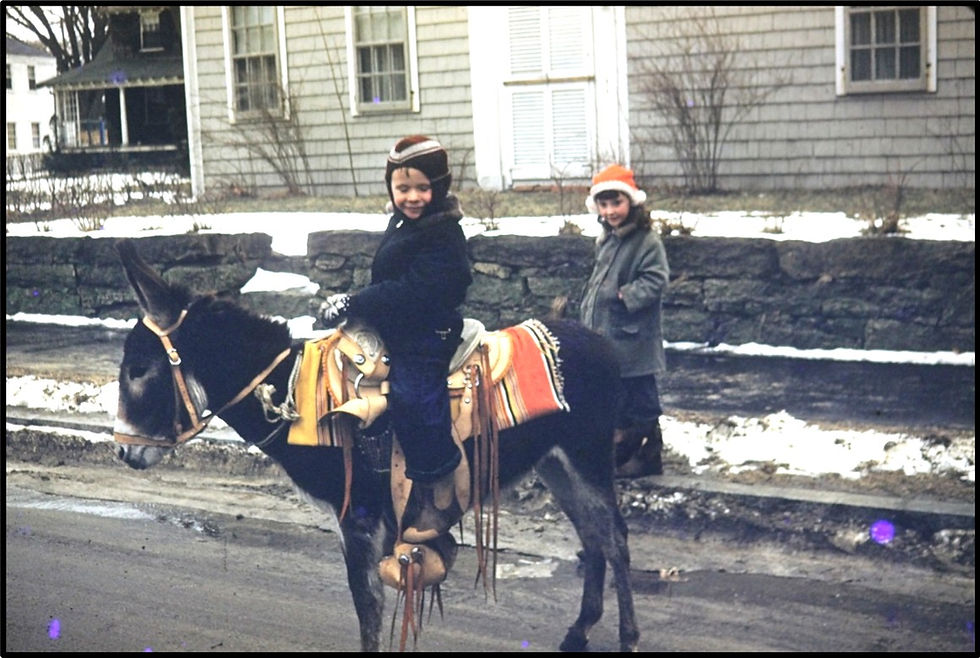
Then imagine that you’re not surprised. This is a common sight in the village. It’s the Russell kids riding their donkey with their friends, the McKeons and the O’Briens, and others, tagging along.
Now of course, there has to be a back story to this.
It all started at the dinner table. It was 1955. Our family, like most, sat down for supper together. We were all there. Mom and dad and the four of us kids—Barbie, Billy, Peter and me. Looking back, I don’t know whatever possessed them, but Mom and Dad started the conversation with, “How would you like to have a donkey?”
Well, this had never entered our minds. We weren’t clamoring, “We want a donkey, we want a donkey.” But somehow, for some reason, they thought it would be a good idea. And of course, once we knew this was a distinct possibility, we were thrilled! Then, for sure, the clamoring began—“When is the donkey coming, when is the donkey coming?”
If they had any second thoughts, my parents knew then there would be no turning back. The die was cast!
Preparations were made. Our backyard was transformed. Dad did some carpentry work. He made a stable inside the old 8- by 10-foot storage shed we had in our back yard. An order of hay was delivered, and a wooden fence was installed to make a corral.
These plans were all made to accommodate what was to be our small, gentle donkey. A “petting-size” donkey—emphasis “small.” Keep this word in mind as my story unfolds.
And then the most important preparation—the four of us decided on a name. Our donkey would be called Pokey.

The day finally came. I can’t remember the exact date, but it was in the fall of 1955. I was 9 years old. Barbie was 7, Billy 5, and Peter 4. Dad, our uncle Howard Carlson, and grandfather Bill Russell, set off in the morning using Gramp’s 1950 grocery delivery panel truck. They had to travel to a town north of Boston to pick up Pokey.
Talk about excited! That doesn’t even come close to how we felt. We were way beyond that…think of Christmas mornings when you were a kid. And multiply that by two! We dressed in our cowboy outfits waiting for our donkey to arrive.
Well, you know that phrase…”the best laid plans”?
The hours passed…and passed. I’m sure my mother was getting concerned. But we were too excited to notice. At last, Gramp’s panel truck arrived. We ran out to the back yard. Squealing with joy. Jumping up and down. The two rear doors to the panel truck opened up.
And what to our “wondrous eyes appeared”? I can tell you it wasn’t Pokey.
Dad and Howard were backing out of the truck feet first. They had been laying on top of Pokey who was on his side. Totally still. Our joyful squeals turned to screams and tears. We wailed, “He’s dead, he’s dead.” He certainly looked like he was!
Then our four sets of eyes turned from Pokey, who at that point had begun to stir, and focused on Dad and Howard. Well, what a sight. Faces beet-red, a cut over Dad’s eye, shirts all askew, one ripped. And the look on their faces. You know the look. We shut up immediately. Of course, our relief from seeing Pokey move helped a great deal.
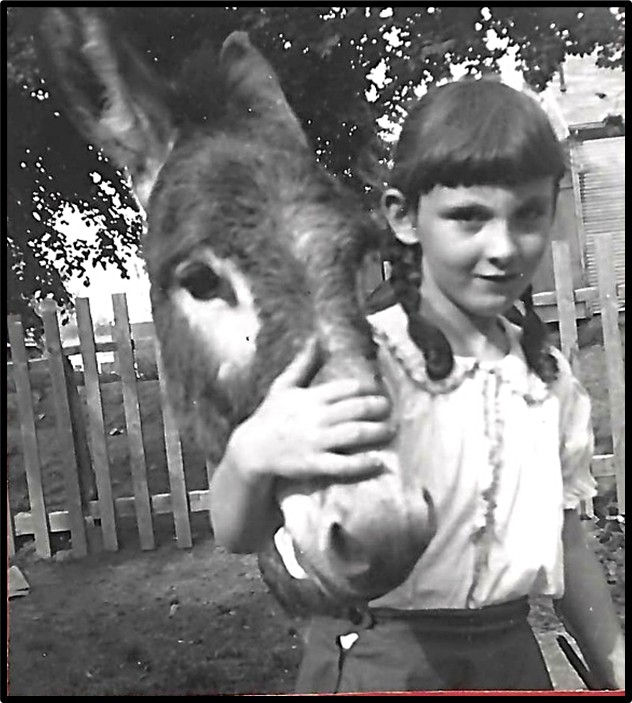
The whole story eventually came out. Upon arriving to pick up Pokey two things were apparent. He certainly was not the petting-size donkey they thought they had purchased. And he had a bit of an attitude. Not a warm, fuzzy, happy donkey they had envisioned.
Decision time. Should they go ahead with the deal or not? Much conversation back and forth—pros and cons. In the end, the overriding questions remained: “How can we go home without Pokey? How can we disappoint the kids? They were dressed in their cowboy outfits for god’s sake.”
So, they decided to purchase Pokey and hope for the best. (Good move for the four of us—bad move for them, as you’ll see.)
On the way home, Pokey apparently decided he’d had enough. Somehow, he kicked open the panel truck’s back doors and got loose. Ready for this—in downtown Boston!
Of course, being cooped up in a panel truck for hours probably didn’t improve Pokey’s disposition!
Somehow, they were able to run after and catch him. Although at this point, I’m sure they were tempted to leave him roaming the streets of Boston! For the rest of the trip Gramp drove and Dad and Howard moved from the front seat to lay atop Pokey in the back of the truck.
I’m glad to tell you that this story ends well. The trauma of his arrival subsided, and we all eventually settled into a routine with Pokey. I will say, though, he lived up to the word most used for donkeys—stubborn. Yes, he was. If he didn’t want you to ride him he wouldn’t buck you off—he just wouldn’t move. We solved that by having someone run ahead of him with a carrot.

We had him for close to three years. We, and our playmates, rode him all over the village streets. Never worried about cars. Of course, there were very few in those days. And by chance if one approached the driver just went around us. But that was then. Can you imagine riding a donkey on our busy Jarves Street now?
At about the three-year mark it was decided to give Pokey to a farm in Middleboro that had other donkeys. In truth, the novelty had worn off for us. And to coax us into agreeing, our parents suggested that Pokey be replaced by bunny rabbits and chickens. Smart move.
They took us to visit Pokey a couple times and he seemed healthy and happy with his other donkey friends. We all agreed that he remembered us—which seemed important to me, somehow.
The Pokey Story has become legendary in our family. Over the years whenever we’d gather it always provided tons of laughter. And to this day, I still have townspeople say to me, “Hey, remember your donkey, Pokey?”
I used the word “idyllic” at the beginning of my story. And perhaps I’ve painted a rosier picture of growing up and living in Sandwich in the 50s than was always the case.
I’ll tell you this, though—I wouldn’t trade it for anything.
Joan Russell Osgood is a member of the Friends of the Sandwich Town Archives, a dedicated, all-volunteer, 501(c)(3) nonprofit organization committed to supporting and promoting the archives’ collections and the rich, diverse history of the town of Sandwich.


What a hoot! Pokey surely was the talk of the town! An odd omission, though: We don't see a photo of Joan aboard Pokey,